Marriages
Anywhere in these islands. On a cliff, in the water, at four in the morning, in a place that would be refused a licence almost anywhere else.
Getting married here is easier than getting married where you live. That is not a boast about the weather — it is the law, and it is worth seeing laid out.
No residency requirement. No waiting period. No witnesses. No blood test. No approved venue. You apply online, collect the licence across a desk on any weekday, and may be married that same afternoon, in any place in these islands you care to stand.
Why Hawaiʻi lets you and your own country probably doesn't
In England and Wales a marriage must take place in a registered building or on approved premises — approval granted room by room. Outdoor ceremonies were not permitted at all until 2021, and even now the open air has to sit within the approved grounds. Exactly two religious groups are exempt and may marry anywhere they like: Jews and Quakers, by a statute of 1753.
Hawaiʻi asks none of this. The State licensed the minister, by name and number, and left the choosing of the place to you. A marriage performed here is valid at home, because formal validity follows the law of the place where the marriage was celebrated.
Who is marrying you
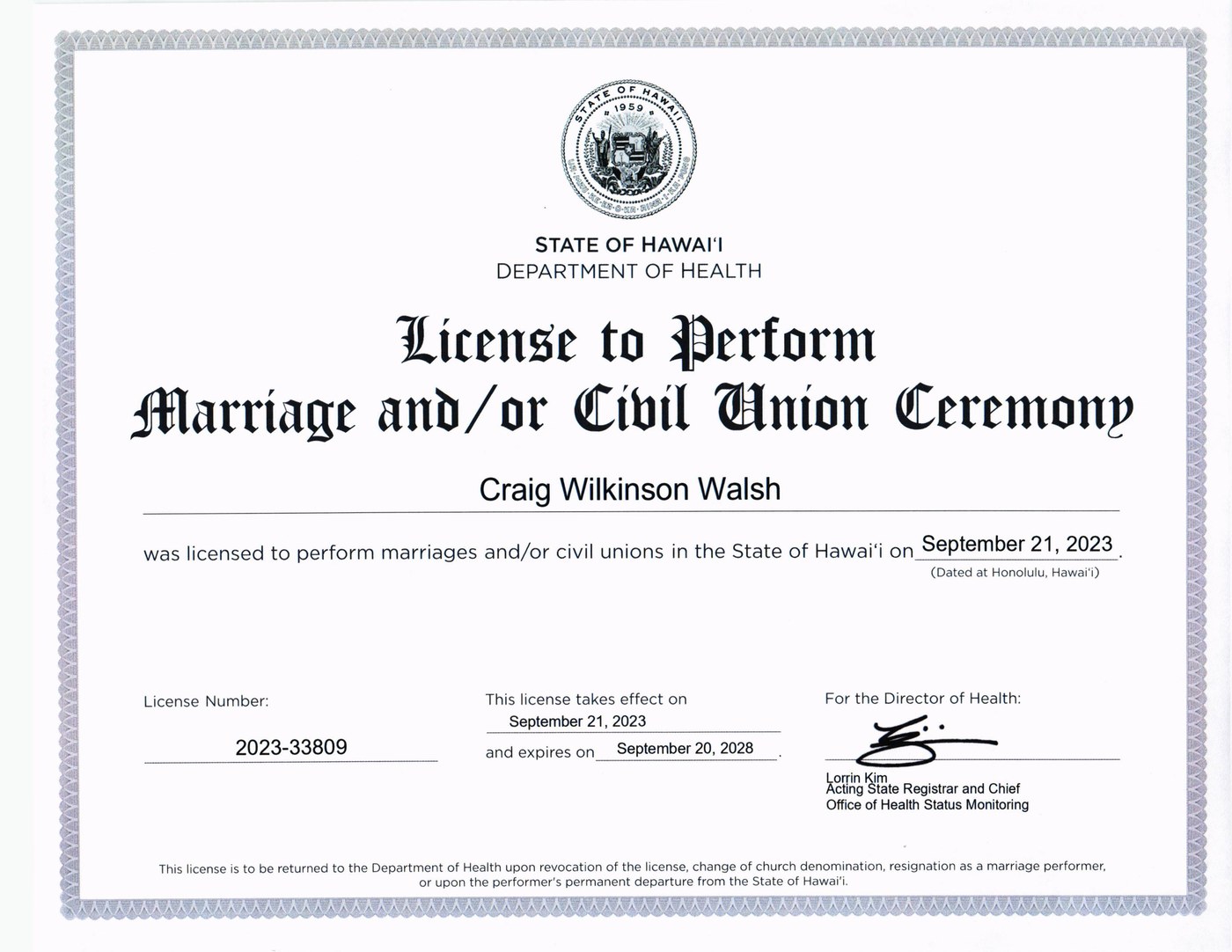
The founding Bishop of this Church holds licence 2023‑33809, issued by the Hawaiʻi Department of Health, valid to 20 September 2028, to solemnise marriages and civil unions throughout the State. He is ordained, has been since 2000, and will marry any two adults who ask.
What it costs
Published, because almost nobody publishes it, and because a church whose cardinal sin is concealment should not make you ask.
| A legal ceremony The words that are required, said properly, in the place you choose. Valid, registered, unfussy. |
$250 |
| A written ceremony We talk first. Then the ceremony is written for you and says what you actually mean, which is the entire point of this Church having opinions about marriage. |
$550 |
| Travel beyond town, or to another island | at cost |
Two fees are not ours and we do not take a share of either: the State charges $65 for your licence, and a few locations require a permit, generally between nothing and $100.
The paperwork, plainly
You apply for your own marriage licence at emrs.ehawaii.gov and pay $65. Both of you then appear in person, together, before a marriage licence agent to collect it.
How long it takes: the same day. The agent issues the licence there and then, on any weekday in business hours — and you may be married that afternoon. There is no processing period and nothing arrives in the post. If you cannot reach the Department of Health office, agents are appointed around the islands and will see you by appointment.
What to bring.
- Valid government photo identification for each of you — passport, driving licence or state ID.
- Both parties must be 18 or over. If either of you is under 19, bring a certified copy of the birth certificate; over 19, any government ID showing date of birth is enough.
- If either of you was previously married, and the divorce was finalised or the former spouse died within thirty days of your collecting the licence, bring the divorce decree or the death certificate. Older than that and no document is needed. A decree not in English needs a certified translation.
There is no waiting period and no residency requirement — you need not live here, and you may collect the licence and marry the same day.
No blood test and no medical examination. Many American states once required one — usually a syphilis screen — and they were repealed one by one from the 1980s onward. Hawaiʻi asks for nothing of the kind.
The licence is valid for thirty days. If the ceremony does not happen inside that window it is void and you begin again, so do not apply months ahead. It is also valid only within the State of Hawaiʻi.
No witnesses are required. Under Hawaiʻi law the whole of what a marriage needs is this: the two of you and the officiant physically present in the same place at the same time, each of you giving consent, and the officiant declaring you married. Nobody else need be there at all.
Which is worth pausing on. The State of Hawaiʻi requires consent and a declaration. Everything else you have ever heard at a wedding — the causes for which marriage was ordained, the remedy against sin, the warnings about what desire will do if left unsupervised — was added by somebody, later, for reasons of their own.
It is not the law. It is editing. This Church declines to perform it.
The one thing worth knowing about the officiant. You are flying a long way for a day that cannot be repeated, and the person marrying you should know which beach needs a permit, which one is a car park at sunset, and where you can actually stand. That knowledge is local, and it is most of what you are paying for.
What the ceremony says
This Church holds that a wedding exists because two people want each other, and that almost every traditional rite is built to say anything but that. The Book of Common Prayer sets out the causes for which marriage was ordained: children, a remedy against sin, and mutual society. Desire appears once, as a hazard to be managed.
We marry people on the opposite premise. Nobody will be told that their wanting is a danger the institution exists to contain, and no one is asked to pretend the day is about anything else.
Asking
Send an enquiry → — your date, roughly where you have in mind, and which of the two ceremonies you want. Nothing is booked and nothing is owed by asking; we check the date is free and write back.
If you would rather just write: [email protected]. Either way you get a real answer from a person.